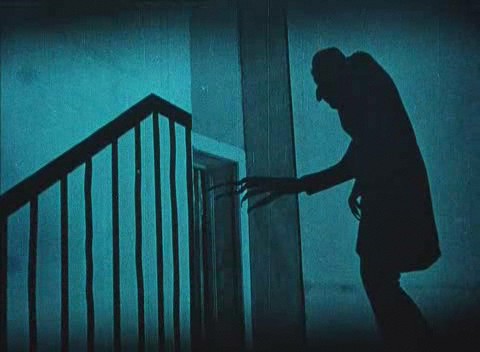
Thursday, March 6, 2008

Spring and Death


"There's a stench in the air, which, from this distance underground, might be the smell of either death or of spring--I hope of spring. But don't let me trick you, there is a death in the smell of spring and in the smell of thee as in the smell of me. And if nothing more, invisibility has taught me my nose to classify the stenches of death."

--Ralph Ellison, Invisible Man (1947)

Monday, March 3, 2008

Alterna-coffins part one


Hi y'all. Thanks for adding me.

I mentioned that ReadyMade magazine (and, I think, AdBusters) did a feature on designers who did a post-modern-age challenge -- designing products for the 21st century -- and that one of the things was a kind of Fed-ex-envelope-lookin' body bag for burial. I couldn't find that article (I'll chase it down later) but I did find the digital reprint of ANOTHER article in ReadyMade about an artist who's designing alternative urns for burial:

http://www.readymade-digital.com/readymade/20070809/?pg=55

It's made me recall some of the work I did at Lanternhouse in Cumbria - they're way into alternative funerals and other rituals (weddings, baptisms, celebrations of all kinds). In fact, when they were run by Welfare State International, they released some books called the Dead Good Guides, which are handbooks for alternative rituals and ceremonies. I have a copy of the Funeral one if anyone wants to read it.

RC

"So I tattoo instructions on my ass / That say 'don't ever put this body in a casket / burn it and put the ashes in a basket / and throw them in the Puget Sound / I don't ever want to be underground.'" - Kimya Dawson

Thursday, February 28, 2008

Antigone and Polyneices


My first quarter of graduate school I chose Antigone
http://en.wikipedia.org/wiki/Antigone as the primary source for my final paper in Intro to Graduate Study. The result is an essay about how Antigone's love for her brother Polyneices drives her to bury him in the ground, thus breaking Kreon's law and ensuring her own death. I argue that it is love and a kinswoman's duty to ensure respectful burial, not a just feminist mentality, that drives Antigone to commit her crime. My research involved burial practices in ancient Greece
http://people.uncw.edu/deagona/ancientnovel/kristina.htm, the origin of Thebes, the myth of Seven Against Thebes
http://en.wikipedia.org/wiki/Seven_Against_Thebes (also known as the Theban Dead, and also immortalized in a play by Aeschylus). Also Antigone was, by the way, the first play of the Oedipus Cycle penned by Sophocles.

This is from a source article titled, "Sophocles' Antigone and the Funeral Oratory:"

"To create a democratic, this is, public funeral, the demos [a rhetorical term for the population of an ancient Greek state] appropriated rites of aristocratic funerals which its legislation had been continually restricting since Solon. The demos displayed the bones for two days...under a tent in the agora [a place of assembly in ancient Greece]. Here, families mourned their husbands, sona and brothers with whatever customs they wished. The concession to familial loss and grief, loosened from normal curbs on public display, contrasts the first two days with the rituals of the third. On the dawning of this day, no longer are the bones distinguished by the names, identities, and economic and social differences that separated individuals
in life. Now they are 'the dead'...while laws denied the family's right to bring outsiders, slaves, strangers, and paid mourners into its funerals, anyone could join in the public ceremony. Setting forth from the agora, the procession moved solemnly toward the [public ceremony]. It was perhaps escorted by hoplites [infantrymen] in full armor; the high-pitched keening of the women fills the air, soon to be superseded by the orator's sonorous words. When the dead arrive at the public cemetery, the mourners seek renewal through an oration that replaces not only the familial rites of fertility and purification but also the praise and laments sung for
individual heroes by poets."

And interestingly, the role of women in burial rites:

"During the archaic period, women exercised influence upon social and political life through their prominence in burial rites. Beginning in the sixth century, legislation was passed that sought to curb their participation and tone down the extravagance of their lamentations and displays of grief. Private funerals, formerly conducted outside and through the streets, were confined to the household. Lament by women in public was prohibited."

Further: "women were the proper agents of burial...in a traditional funeral women performed fertility rites to assure the dead a quiet rest and to purify the land for the living. Bewailing the dead, women beat their breasts, lacerated their cheeks, and called upon the dead."

Women played a major role in ancient Grecian burial, but so did the state. This was the role death played in society during Sophocles' time, and so he wrote a play the people could identify with. The people of Thebes in his play are strictly forbidden from burying Polyneices because he is considered a traitor. The proper punishment for a dead traitor is also a horrific punishment in terms of displeasing the gods and barring a soul from moving into the underworld. Burial was vital, and Polyneices was left exposed to decay and be feasted upon by animals. "The ancient Greeks had distinct methods of burial, and it was often believed if you were not provided a
proper burial along with the appropriate rituals, you were destined to suffer between worlds until your rites of passage into the underworld were completed." This is from Kristina Bagwell's website on burial rituals and the afterlife in ancient Greece, linked above. Antigone is not just a woman who defies the leader of the state, who happens to be a man. She is a sister ensuring the rightful passage of her departed brother, as is her duty to do. As she argues in the play, the will of the gods be done, not obedience to a law instituted by just one man.

"No suffering will be so terrible/as to die for nothing." --Antigone

"If you must love somebody/go down there and love the dead." --Kreon

Originally Posted by DINA

Monday, February 25, 2008

Love and Death in the Time of Antigone

Hey all,

So...I wrote a post about Antigone and funeral/burial practices in ancient Greece. But for some reason, whenever I try to post it, a large portion of my text vanishes. But, oddly, you can read the whole thing as a draft under "Edit Posts." So there you go. I'm going to leave it there, sorry for some reason I just can't get this particular post to post in its entirety.

Thanks,
Dina

Wednesday, February 20, 2008

The Humans Are Dead

Special thanks to Dana Dardai...a different take on death-inspired music. He. He.

Tuesday, February 19, 2008

Death Inspired Music


Several weeks ago a newly released boxed set of murder ballads and disaster songs from the early years of the twentieth century called "People Take Warning!" was reviewed on NPR.

A few of the song titles:

The Fate of Talmadge Osborne
Burning of the Cleveland School
The Death of Floyd Collins
The Little Grave in Georgia
The Murder Of the Lawson Family
Fate of Rhoda Sweeten
Poor Ellen Smith
The Sinking Of The Titanic
The Unfortunate Brakeman
Memphis Flu
Tennessee Tornado

I would love to listen to some of these tracks, to experience how death cultivated art for the ears eighty years ago. They sing of death, and now dead themselves, they are memorialized in this box set and available on Amazon.com. So it goes. People often sing of sorrow, and murder and death still rise to the surface in todays music--for some reason, "Jany's Got a Gun" comes to mind, although I am sure there are stronger contemporary examples out there--but these tunes, just from their titles, speak of an unashamed examination of death. There's no veiled language here, no metaphors, just Death, exactly as he stands. No frills, no fear. Just Death.

Monday, February 18, 2008

Respecting the Dead

Among the truly stupid things I remember doing in high school was the afternoon that I and a small group of bored, Byron-lite theatre students decided to go visit a mausoleum.

Dressed as vampires.

I said it was stupid.

Some of us only went in black clothing wearing terrible-tasting fangs and crazed expressions. At least one of us went for the full Bela Lugosi effect, with a flowing cape, pale white face paint, large white fangs over individual canines, and that trickle of blood near the corner of his mouth.

And we marched up and down the halls of the mausoleum as if we owned the place, as if the whole thing was some kind of monument to the characters we were playing, ignoring the obvious fact that vampires visiting mausoleums on a bright spring day would doubtless have burst into flames between the parking lot and entrance. Ultimately, one of the attendants chased us down and threw us out, telling us we should be ashamed of ourselves for our lack of respect for the dead.

Think about that phrase: "Respect For The Dead."

It's the idea that simply by finishing your natural term of conscious existence you will have earned a sort of nebulous admiration from those of us who remain living. We are asked to show reverence for one's state of death even though it is in fact nothing special, even though it is the one thing that unites every living creature that has ever existed on this planet. We go to funerals that overflow with silence, because noise would be disrespectful, apparently, to the one person in the room for whom noise no longer means anything.

I'm not excusing the behavior of myself and my youthful pre-goth peers. The mausoleum staff had every right to throw us out for making a nuisance of ourselves. My point is that the attendant wasn't demanding that we show more respect to the dead, he was asking that we show more respect to the living, to the actual grief felt by the people who were there to wade in the memories of their loved ones...as opposed to those who just showed up to clown around in bloodsucker clothing.

That's what he was asking, but he said we should Respect the Dead.

Why? Why is this phrase so prevalent? Why can't we agree that showing some reverence for a living being's emotional turmoil is on its own a reasonable request? Why drag the dead into it?

Is it an attempt to use fear as a disciplinary tactic--to threaten the offenders with retribution by restless spirits--because merely pointing out the pain you cause others isn't as effective a declaration? Is it in fact a personal, internal fear, that the disturbances caused by others will lead to these same spirits going after you?

A number of famous stories and films have been made on the subject of disturbing the sleep of the dead and the consequences thereof. I can't think of even one story as famous in which characters only disturb the grim solace of the bereaved living and suffer as a result.