Monday, February 18, 2008

Buddhist Meditation Part 2

(The following is the meditation on death from "Transformation and Healing: Sutra on the Four Establishments of Mindfulness" by Thich Nhat Hanh -)

"Bhikkhus, imagine a sack which can be opened at both ends, containing a variety of grains: brown rice, wild rice, mung beans, kidney beans, sesame seeds, white rice. When someone with good eyesight opens the bag, he will review it like this: 'This is brown rice, this is wild rice, these are mung beans, these are kidney beans, these are sesame seeds, this is white rice.' Just so the practitioner passes in review of the whole of his body from the soles of the feet to the hair on the top of the head, a body enclosed in a layer of skin and full of all the impurities which belong to the body: 'Here is the hair of the head, the hairs on the body, nails, teeth, skin, flesh, sinews, bones, bone marrow, kidneys, heart, liver, diaphragm, spleen, lungs, intestines, bowels, excrement, bile, phlegm, pus, blood, sweat, fat tears, grease, saliva, mucus, synovic fluid, urine.'

This is how the practitioner remains established in the observation of the body in the body; observation of the body from within or from without, or from both within and without. He remains established in the observation of the process of coming-to-be in the body or the process of dissolution in the body or both the process of coming-to-be and the process of dissolution. Or he is mindful of the fact, 'There is a body here,' until understanding and full awareness come about. He remains established in the observation, free, not caught up in any worldly consideration. That is how to practice observation of the body in the body, O bhikkus...

As a skilled butcher or an apprentice butcher, having killed a cow, might sit at the crossroads to divide the cow into many parts, the practitioner passes in review the elements which comprise his very own body: 'Here in this body are the earth element, the water element, the fire element, and the air element.'

This is how the practitioner remains established in the observation of the body in the body; observation of the body from within or from without, or from both within and without. He remains established in the observation of the process of coming-to-be in the body or the process of dissolution in the body or both the process of coming-to-be and the process of dissolution. Or he is mindful of the fact, 'There is a body here,' until understanding and full awareness come about. He remains established in the observation, free, not caught up in any worldly consideration. That is how to practice observation of the body in the body, O bhikkus.

Further, the practitioner compares his own body with a corpse which he imagines he sees thrown onto a charnel ground and lying there for one, two, or three days, bloated, blue in color, festering, and he observes, 'This body of mine is of the same nature. It will end up in the same way; there is no way it can avoid that state.'

This is how the practitioner remains established in the observation of the body in the body; observation of the body from within or from without, or from both within and without. He remains established in the observation of the process of coming-to-be in the body or the process of dissolution in the body or both the process of coming-to-be and the process of dissolution. Or he is mindful of the fact, 'There is a body here,' until understanding and full awareness come about. He remains established in the observation, free, not caught up in any worldly consideration. That is how to practice observation of the body in the body, O bhikkus.

Further, the practitioner compares his own body with a corpse which he imagines he sees thrown onto a charnel ground, pecked at by crows, eaten by hawks, vultures, and jackals, and infested with maggots and worms, and he observes, 'This body of mine is of the same nature, it will end up in the same way, there is no way it can avoid that state.'

This is how the practitioner remains established in the observation of the body in the body; observation of the body from within or from without, or from both within and without. He remains established in the observation of the process of coming-to-be in the body or the process of dissolution in the body or both the process of coming-to-be and the process of dissolution. Or he is mindful of the fact, 'There is a body here,' until understanding and full awareness come about. He remains established in the observation, free, not caught up in any worldly consideration. That is how to practice observation of the body in the body, O bhikkus.

Further, the practitioner compares his own body with a corpse which he imagines he sees thrown onto a charnel ground; it is just a skeleton with a little flesh and blood sticking to it, and the bones are held together by the ligaments, and he observes, 'This body of mine is of the same nature. It will end up in the same way. There is no way it can avoid that state.'

Further, the practitioner compares his own body with a corpse which he imagines he sees thrown onto a charnel ground; it is just a skeleton, no longer adhered to by any flesh, but still smeared by a little blood, the bones still held together by the ligaments...

Further, the practitioner compares his own body with a corpse which he imagines he sees thrown onto a charnel ground; it is just a skeleton, no longer adhered to by any flesh nor smeared by any blood, but the bones are still held together by the ligaments...

Further, the practitioner compares his own body with a corpse which he imagines he sees thrown onto a charnel ground; all that is left is a collection of bones scattered here and there; in one place a hand bone, in another a shin bone, a thigh bone, a pelvis, a spinal column, a skull...

Further, the practitioner compares his own body with a corpse which he imagines he sees thrown onto a charnel ground; all that is left is a collection of bleached bones, the color of shells...

Further, the practitioner compares his own body with a corpse which he imagines he sees thrown onto a charnel ground; it has been lying there for more than one year and all that is left is a collection of dried bones...

Further, the practitioner compares his own body with a corpse which he imagines he sees thrown onto a charnel ground; all that is left is the dust which comes from the rotted bones and he observes, 'This body of mine is of the same nature, it will end up in the same way. There is no way it can avoid that state.'

This is how the practitioner remains established in the observation of the body in the body; observation of the body from within or from without, or from both within and without. He remains established in the observation of the process of coming-to-be in the body or the process of dissolution in the body or both the process of coming-to-be and the process of dissolution. Or he is mindful of the fact, 'There is a body here,' until understanding and full awareness come about. He remains established in the observation, free, not caught up in any worldly consideration. That is how to practice observation of the body in the body, O bhikkus.

- end of meditation

I couldn't believe my luck when I found this meditation on death to follow up on my december blog post. I wasn't even looking for it. Serendipity + death = one happy buddha.

But in all seriousness - when I read through this for the first time, I was struck by the sheer length of it, as well as the detail, and I thought it was incredibly morbid. Good lord. You want me to sit in the lotus position and meditate on charnel ground and ligaments and smeared blood and cows by the side of the road for how long?...but then the repetition, and the tempo of the prose started to do its work and everything fear-based fell away. The thoughts and the details fell away and all that was left was...a little bit of humor, and a realization that THAT is all it is...details.

I also appreciate the awareness of the simultanaiety of the "process of coming-to-be" and the "process of dissolution". This is a theatrically sophisticated meditation.

I remember the conversation we had at the last meeting; I mentioned that I thought all this study on death would have a negative effect on my emotions but that in fact it was taking away my fear. And John said something about studying death to learn to be as present as possible.
So I would like to try this meditation, to sit in my stewy body while someone reads this to me. Anyone interested?

Friday, February 15, 2008

The Lasts of the Lines

Some deaths clearly represent more than others. Though disruptions to particular lives might be great, most individuals pass without causing anything approaching epochal perturbations to the worlds they leave behind. Conversely, the deceased rarely carry the weight of cultural tradition and continuity into the Beyond. Even the deaths of world political and religious leaders don’t cause societies to cease to function for any real period of time. Certainly nations may mourn, people may intensely reflect, and power struggles may ensue, but daily rituals resume, memories persist, and life goes on. Except when it doesn’t.

One question that has come to mind now and again as part of this project is how to get an audience to move beyond simply the death of an individual (or even large groups of individuals) to experience those rare instances when much more than a body and life goes to the grave. What does it mean when a sizeable piece of supposedly collective memory, a language, or even an entire culture dies with a solitary person? What happens when the things known and experienced by the dead cannot even be comprehended by any other living soul on earth. What does the individual experience when they look forward to see the inevitable and look back and side to side-to-see that they are truly the last of a line? As performers, writers, and researchers is there anything we can do to convey that experience to an audience?

* * * * *

This has nothing whatsoever to do with I Am Legend. I did not see the movie, though I read the book years ago and can imagine it could fit with the theme. The initial inspiration for this post was a story that I remembered coming out of Canada about a year ago. Six hundred sixteen thousand six hundred and thirty-six Canadians fought in the First World War. As of the November 2006, there were three left alive, all over age 105. As the disappearance of this generation approached, the Canadian Parliament passed a resolution to hold a state funeral for last surviving veteran. By February '07 Lloyd Clemett died, leaving only two. Percy Wilson died a few months later. This left only John Henry Foster Babcock, 146th Battalion, Canadian Expeditionary Force.

If you think that seemed like a morbid sweepstakes to win, you weren't the only one embracing it. A survey taken in Fall 2006 found that 75% of Canadians were in favor of the state funeral. It seemed a venerable way to commemorate the loss of a direct connection to a significant moment in the nation's history. The problem was that none of the veterans alive at the time of the resolution's approval wanted the honor. The three agreed that bestow the honor on one could not possibly commemorate all of them. The deeds and death of one could not possibly carry the weight of all that history and experience. (To make matters more intriguing, Babcock never saw action and has actually lived in Spokane, WA since the 1920s. He will die an American citizen.)

* * * * *

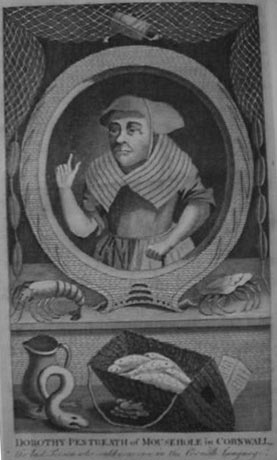
Two much more dramatic examples of cultural extinction come to mind. The first is that of Dolly Pentreath who died in her home in Mousehole, Cornwall, England in December 1777. Dolly is widely acknowledged as the last native speaker of Cornish on Earth. There were no documented native speakers after her death, though the language has survived in snippets and revival attempts in the centuries following her death. One estimate has the total number of fluent, non-native Cornish speakers at 300.


Much has been mythologized about Dolly Pentreath. Stories abound about the fish-wife (though she never married an actual man) and her cursing, beer drinking, and pipe smoking. Most of all there was her refusal to use anything, but Cornish though she spoke English. Legend has it that her final words were "Me ne vidn cewsel Sawznek!" ("I don't want to speak English!").

Regardless of the specific truths behind Dolly lore, it does seem as if she knew that she may be the last true speaker of her beloved Cornish. This was largely due to her story being recorded in-person by antiquarian Daines Barrington. It is certainly possible that Barrington found her by chance and not because she was the true last speaker. Nevertheless the question remains: how might we convey to an audience the understanding of death by someone facing death not only as a human, but as the carrier of a tradition and culture they hold to so fiercely.

* * * * *

San Nicolas was home to a tribe of Native Americans about whom little is known. They probably spoke a language from the widespread Uto-Aztecan family, but when The Lone Woman of San Nicolas was eventually brought from the island to the mainland at the request of missionaries, none of the local Indian translators were able to communicate with her. The decline of the San Nicolas population probably began shortly after contact with Europeans in the 17th century due to disease and/or resource and trading pressures brought by the settlers. A crisis point was reached between 1810 and the mid-1830s as fleets of Russian and Aleut fur trappers hunting the island's large seal population sparred more frequently with the indigenous population. In 1835, missionaries evacuated everyone from the island, except one 20-something woman who was believed to be missing her child.

The woman was baptized as Juana Maria in the final weeks of her life. For the 18 years prior she lived alone on the island of San Nicolas, about 50 miles off the coast near Los Angeles. She was finally brought from the island by Captain George Nidiver. Because no one was able to communicate with her beyond crude sign language, we do not know what life was like alone on the island or how she reacted to being the last of her people to live any semblance of a traditional life on their ancestral island.

It does appear that she lived reasonably well under the circumstances. She was described as being in good health and eagerly interacted with Capt. Nidiver and his crew. Further, she was said to be "astonished and delighted" by the "civilization" she found on the mainland, perhaps indicating that she may have believed that she would never see people or society again. Sadly, she contracted dysentery shortly after reaching the mainland and never recovered. She would die under the care of Capt. Nidiver's wife, but without any knowledge of the fate of her people and with an unknowable sense of her place in her people's history.

Where in the World is Carmen Santiago's Body


(Heath Ledger's apartment, NYC)

Here's an little interesting Google Map mash-up of where various celebrities died in NYC.

I remember seeing a similar map mash-up indicating the various cemeteries where celebrities' bodies are located but I have to say that I've never really responded to any of this cemetery stuff. The actual location of a death seems far more intriguing to me than the sites where we sanitize it all with our rituals.


(New Orleans' home, owner unknown)

Wednesday, February 13, 2008

Lady Bluebeard


Yesterday there was a really fascinating article on the front page of the Chicago Tribune about Belle Gunness, also known as "Lady Bluebeard," a serial killer who lived on a farm near La Porte, Indiana in the first years of the twentieth century. The article focuses on a student forensic anthropologist's attempt to uncover whether the body currently buried in Belle Gunness's grave is, in fact, Belle Gunness. This is another side to How the Dead Speak; only this time, the subject is a serial killer.

Gunness was a wealthy Norwegian widow who lured suitors to her quiet farm via charming and explicit love letters, promising marriage. When a suitor arrived at her home, she fed them a hefty old-fashioned Norwegian meal laced with strychnine, waited for them to die, then took them to the cellar where she would then dismember the body and bury the remains in the hog pen.

The world came to know Belle Gunness when her farm burned to the ground in 1908, allegedly killing her and her three children. Her body, however, when discovered, was headless. A relative of one of Belle's many doomed suitors was the one who insisted that authorities search the property for bodies. They did, and they found more than just one body:


They found 11. It is estimated that Belle Gunness killed as many as thirty people during her lifetime. From the article:

Gunness' first husband and two of their children had previously died unexpectedly after suffering from symptoms of poisoning. She collected life insurance on all three. A week after Gunness remarried, her new husband's baby from a previous union was dead, Simmons said. Several months later, her husband died when a sausage grinder allegedly fell on his head. Again, she collected life insurance.

She became a legend, labeled by the nickname "Lady Bluebeard." Rumors swirled for years after the fire that Belle's "body" was someone else's, and she had faked her death. That is what this forensic anthropologist is trying to find out. I can't wait to find out too. Did she fake her death, or did she die? The alleged body of Belle Gunness has been exhumed, and its headless remains are being examined, and DNA pulled to compare to DNA in the saliva Belle left behind on one of her love letters to a victim. He had opened the envelope with a letter opener, thus the preserved DNA.

Above all, it amazes me that I never heard of this story before--that a serial killer was discovered not very far away in La Porte, Indiana (which I have visited), only twenty five or so years after Dr. H. H. Holmes confessed to murdering 27 people, although he may have murdered many more. H.H. Holmes is the subject of Erik Larson's book Devil in the White City. When I think of Holmes and Gunness, I think of how killing must have brought them some form of joy; a pleasure that ordinary life cannot bring, but rather bringing the end of life. Perhaps it brought them peace, as if fulfilling some void that other humans possess naturally. Or maybe it was just power.

Tuesday, February 12, 2008

Incense and Nakedness


Though this isn't something I read or watched, it was something that I thought was a fantastic story. My uncle just passed away last week, two days before the Asian New Year. Sunday was his funeral, I was unable to go because it was in California.


Anyhow, my brother was standing outside with my aunt, uncle, and cousin, and this is how that conversation went (P.S. it was a Buddhist funeral):


Brother: Uncle Ted, are you okay?
Uncle Ted: (Wiping eyes) Yeah, I just can't handle the incense. It drives me crazy.
Crazy Aunt: Yeah, I can't stand it in there! Do me a favor, when I die, forget all this fucking chanting. Just throw me a fuckin' party!

Disillusioned Cousin #4058: If I have an open casket, I want to be buried naked. Just let it all hang out...

(sound of gong)


Anyhow - actual post to follow re: some more Buddhist death deliciousness.

Monday, February 11, 2008

When all tomorrows are laid to waste

What if I said that [the boy i]s a god?

The old man shook his head. I'm past all that now. Have been for years. Where men cant live gods fare no better. You'll see. It's better to be alone. So I hope that's not true what you said because to be on the road with the last god would be a terrible thing so I hope it's not true. Things will be better when everybody's gone.

They will?

Sure they will.

Better for who?

Everybody.

Everybody.

Sure. We'll all be better off. We'll all breathe easier.

That's good to know.

Yes it is. When we're all gone at last then there'll be nobody here but death and his days will be numbered too. He'll be out in the road there with nothing to do and nobody to do it to. He'll say: Where did everybody go? And that's how it will be. What's wrong with that?

- From The Road by Cormac McCarthy (pp. 172-3)

Meeting notes 2-3-08

FOOL MACHINE COLLECTIVE MEETING NOTES
Meeting Time: 2/3 Super Bowl Sunday, at Konak’s
Attending: John Pierson, Luke, Kurt, Jessica Anne, Tanya, Peter

*The Giants won. We toasted, insincerely, with a “yay.”

-- FIRING SQUADS.
- The latest posting on the blog before this meeting was Kurt’s, about firing squads. Kurt found some information on firing squad statistics and techniques from all over the world, particularly in Thailand, where they set up a canvas screen that one officer shoots through, while the accused is tied with his hands above his head, on a cross.
- John brought up “GUILT” as a possible theme for shows. Specifically, looking at the audience as “judge.” This fits in with Ryan’s idea of giving the audience a task, or journey, that they go through during the performance (“Your task is to ‘survive’ the following experience.”)

*I have written “audience’s experience as separate.” Anyone know what that is in reference to?

-- PERSONAL EXPERIENCE WITH DEATH.
- John proposed an “action item:” to encourage the comment section on the blog as chances to relate personal, first-hand experiences with death, whereas the post areas are mainly dedicated to factual, read information. (I’d amend that in retrospect, considering Dina’s very excellent posts concerning her friend’s mother’s death, which is a very immediate and complicated story, which does need the space as a main post; more discussion about this later? - Kurt)

-- PHYSICAL STEPS OF DEATH
- Tanya made a connection between the steps of death (decomposition) and the steps towards acceptance when in mourning.
- possible exploration of these steps; “itemizing” the steps, looking at each one as individual inspiration for stage pictures, themes, etc. Also good material for physical workshops? “translating those steps into physical space”

*Note: Tanya has access to a cold, cold, cold roof.

-- PHOTOGRAPHY AND DEATH
- this seems to be a common reoccurrence in discussion. Worth looking into more deeply. John assigned Kurt the task of getting his words together regarding this theme.
- performance idea: create the setting of the death of an audience member
- maybe Peter’s delay camera can be used for this

-- “CLINICAL” ANALYSIS
- Discussion about the “Sterile Room,” a performance idea where individual audience members are analyzed, objectively, as bodies. The staging of this would be “hospital-like”, surgery room-ish, where the performers are in an enclosed (curtained?) space with the lone audience member. This form will continue to be discussed by the collective.

-- DEATH AND MORBIDITY
- Continue to stray away from death as a morbid idea, and look at it in a “positive” light, or at least that which gives meaning/joy/appreciation/whathaveyou to life. Peter comments on Greek mythology, where the gods are jealous of man, because they are able to die, so their life is that much more meaningful (and that’s why the gods fuck with people.)

*performance idea: Book of Death – recording dates of birth for the audience, lining them up and having them record their birth and death in a kind of logbook

-- PREPARATION OF DEATH
- exploring the clean up of death, what is done to “change the room” when there is a death. Luke brings up personal story of his friend (“Eugene sent me a text message that our friend had been eaten by an alligator”)
- Peter comments on a specific industry that cleans up after people who have died alone.

*I have written: “box of last thoughts that you would have before you died”. Anyone know what that is?

*performance idea: eulogies, and living wakes for audience members

*I have written “cheese death” Anyone? Anyone at all?

-- Jessica comments on the box of ashes, and there is some discussion as to what it is that goes into the box, by the time the family gets it (teeth?bone? hair?)

-- AUDIENCE AS DEAD
- Some discussion on the state of the audience as they go through the performance event. “They’re dead from the get-go,” or the idea that the audience members should be going through the experience as an objective body. We should continue to differentiate between “death” and “dying”; the difference between death through the perception of being dead, and death through the perception of being alive

-- NEXT MEETING we should have some carpenters there that can help with making the audience boxes